Saturday, February 19, 2011

Marathon des Sables - About the Event

The Marathon des Sables (Marathon of the Sands) is an iconic event in the world of ultra-marathons. It is held in the Sahara Desert in Morocco in March / April each year and the course is unknown to participants until they arrive at the event.

Competitors must carry all personal belongings and food for the entire event in their backpack. Water and tents are supplied by the organizers.

Competitors congregate in the town of Ourzazate (pronounced Waah - zar - zar - tay) and are taken by bus into the desert. On the bus, the event details are provided to them. The next day is an administration / acclimitsation day where the necessary medical checks and checks of compulsory gear / food requirements and only then, are you cleared to start.

Each participant sleeps with 7 other tent mates under a tarpaulan style beduoin tent, that is best described as shelter rather than a tent, as it remains open to the elements. The race each year has around 800 participants, so its always best to have ear plugs... there has to be a few snorers in that many people!!

Distances vary each year, but I have seen some stats on the average distances on the various days of the event for the past 5 years or so, and they are as follows:

Day 1: 30km - just to ease you into the event
Day 2: 35km - a solid day out on the desert, hopefully no blisters yet
Day 3: 38km - by now your legs are getting the hang of this event... hopefully
Day 4: 78km - yes, the big day. The first 3 days are a prelude to this day.
Day 5: Rest day... competitors have around 34 hours to complete day 4, so some competitors sleep in the desert at various check points, or where they feel comfortable, and finish the next morning.
Day 6: 42k - a marathon. I hope you got some rest yesterday, you have a full marathon to do today... but take heart, once this day is done, you're almost home!
Day 7: 16km - just an easy jaunt to the finish line to pick up your medal.

What makes this event so iconic is that it challenges you on so many fronts. Sure, there is the actual distance - something that you cannot underestimate, you must respect the distance and manage your energy and resources.

Secondly there is your backpack. It is your home for a week and you have to carry it, so it has to be comfortable and big enough to carry all your needs, but light enough so you can move with it. Efficiency in packing is the way to go. As a result, most people take a combination of freeze dried meals (simply add water), gels and energy bars to get through.

Thirdly there is hygiene. There are no showers, toilets etc, so you need to make sure you dont get sick and maintaining appropriate hygiene is important. Its hard to run if you have the trots every day....

Fourthly there is the comfort v weight trade off. Do you want to bring a stove to heat up your meals? Or just use water and cook them in the hot sand? Do you want to bring a sleeping mat to put under the sleeping bag... but then you have to carry it.

Really, the event is all about trade-offs and choices. You can take your bar fridge, a 4 seater couch and a tv... if you can carry it! You can try and run at olympic 5km pace... but if you've knackered after 25 mins... you still have a long way to go! You can walk it... but you'll be out there for a long time and will you have enough water to get to the next check point (about 10kms apart, and you get 1.5 litres at each check point).

Its a magic event because of the combination of all these challenges, and that's even before you consider the terrain (sand dunes, dried river beds, extensive rocky ground, hills and mountains so steep you need a rope to climb up them...), the day time temperatures (up to 49C) or night time chills (down to 3-5 C).

Entry for Australian's is through an American company called Dreamchasers. This what how Dreamchasers describe the event...

The Marathon Des Sables (or MDS) is a 145 mile, seven-day stage race conceived and organized by Frenchman Patrick Bauer and Atlantide Organisation Internationale. While the event can be very demanding if you are racing, the daily time cut-offs are generous enough to allow someone to power-walk the entire 145 miles. Consequently, it is not necessary to be an elite runner to take part in the Marathon Des Sables.

During the event, competitors run on foot through some of the most beautiful, remote sections of the Moroccan Sahara while carrying a backpack with essential gear, food, sleeping bag and clothing for the week. The race organizers provide water (generally 9 liters per day) and a traditional, two-sided Berber tent each night for sleeping during the seven days of racing.

There are six stages over the seven days, with the first three daily stages set around 20 miles each. The fourth stage is around 50 miles; the fifth stage is always a full marathon of 26.2 miles, and the sixth (and last) stage is from 9-12 miles.

Runners are typically given 40 hours to complete the 50 mile stage, with most finishing the stage in one day. This essentially provides most people with a rest day in between the 50 mile stage and the Marathon stage. Each year brings a new course, which is not revealed until two days before the race.

The terrain at the MDS is not all giant sand dunes. In fact, most of the course is run over salt flats, dried up river beds, rocky desert plains, and ancient, dried up lakes. And, it is not uncommon for the course to wander through a remote desert village. The course is usually well marked and all competitors receive a "Road Book" which provides an official course description for each stage.

Temperatures can be extreme, with possible daytime highs reaching 125°F and night-time lows of 38°F. Additionally, the occasional sandstorm can add to the mix. Thus, competitors should be prepared for anything.

As a further guide, here are some pictures of prior events, to give you an idea of the terrain, the gear participants carry, and the Moroccon scenery...


Tuesday, December 28, 2010

Hawaii Ironman

Thought I would put some links to my race reports from the Hawaii Ironman in 2008 on this blog.

Three main links are worth noting.

Race report in pictures:
http://ironmanchris.wordpress.com/2008/10/18/the-hawaii-ironman-experience-in-pictures/

Race report
http://ironmanchris.wordpress.com/2008/10/13/chris-aylen-you-are-an-ironman

Getting a spot in the event
http://ironmanchris.wordpress.com/2008/08/01/the-journey-begins-aloha-lottery-winner/

Cut and paste those links into the browser for the links, else try www.ironmanchris.wordpress.com etc .

Thursday, December 9, 2010

Ironman Western Australia 2010

Having had two very poor IM events in late 2009 (Canada and WA), but a great marathon in between the two of those events, I changed focus and concentrated on doing marathons and ultra marathons in early 2010, finishing two official marathons, the Comrades ultra marathon in South Africa and many other marathon and longer training runs and unofficial events.

2010 also saw my first DNF during the Gold Coast 100km run, when my hips basically seized up and I could barely walk and couldnt get up a set of stairs out on the course. Even I know its time to DNF at that point....I couldnt crawl 45km! (well not in the time limit anyway!).

Unfortunately that injury meant I had substantial time off training and with a miserably wet and cold Melbourne winter, motivation to get out of the central heating to swim, bike or run was at an all time low.

From 23 May til 10 October (20 weeks), I swam a total of 25km, biked a total of 790k and run a total of 367km (of which just over half - 186km - were in Comrades, GC 100 attempt and GC marathon). This was hardly the traiing required to complete an ironman which was just 8 weeks away!!

And then the Hawaii Ironman happened. I watched the event unfold on my PC, reading all the updates, getting caught up in the excitement of the event, with memories back to 2008 when I was out their on the course myself. It was a great result for Australian triathlon and the motivation switch inside me flicked to "on". I had a lot of work to do, my swimming was terrible (1km in 25 mins), I was averaging 25kph on short bike rides and I was having significant trouble with shin splints on the run.

So I needed a plan, a cunning plan, and I decided I would try something different. Conventional ironman training wouldnt work, so I went back to what always worked at school when you had a test coming - you crammed.

So I set about a "balanced cram" program. It had to be balanced as I didnt have time to get injured and recover before race day.

The plan was to increase the cycling first (non weight bearing so would be good for the shins and taking it slow should help the hips), then the running and finally the swimming. There would be no speed work, it was all about getting the distance in the legs.

For the next 7 weeks, my training distances increased sharply:

Swim Bike Run
Week 1 (km) 5.0 78 13
Week 2 2.2 339 30
Week 3 5.0 226 19
Week 4 3.0 323 46
Week 5 5.5 190 37
Week 6 5.7 374 50
Week 7 8.5 134 24

At the start of this block, I thought I might finish, but it would take a bloody long time and I would be a mess. As time went on, I was thinking I would finish, and it would be about 14 hours.

During this 7 weeks I had done three 150k bike rides (one with a 10k run off the bike) and three runs of over 20km (the longest at 28k).

I had a two week taper. Week 7 was the start of it and the distances biked and ran dropped substantially, replaced by more swimming. Week 8 was race week, and there was NO running at all in this week.

Monday of race week was a 4km swim, Tuesday was a travel day, Wed & Thurs 30 min swim on the course in the wetsuit and 30k bike ride, Fri a 10 min swim and that was it.

That taper did mean that Jill and I were able to see some of the local sights around Busselton in the days before the race.

We headed down to some beautiful beaches (below is Bunker Bay)


IMWA is the last event for 2010 and what a year it has been.

And also stopped into a chocolate factory to sample some of their finest!


This was the first year that the World Triathlon Corporation was running all aspects of the event, and they pulled out all stops to make it a good show, including a whizz-bang set up for the welcome party on the Friday night before the event (race day is Sunday).


For the first time in the 7 year history of the event, the finish line would be in the main part of town (not a nearby park as in the previous 6 years). And the finish line area looked great. The run course was a 4 lap course, passing through town each lap, so you got a chance to feel the atmosphere each time before heading back out to the main part of the run course.


And then finally the final preparations were down, and it was time to put the bike and gear bags into transition.


RACE DAY

The forecast for race day was kind, low 20's, mostly cloudy with a chance of light rain/drizzle, and moderate winds. I say kind because it had a blown a gale the previous 5 days, and been 38 C the previous year and was 37C when we arrived on the Tuesday before the race.

A time goal didnt really matter, but I thought given the conditions and how well the cramming training plan had gone, I might be able to do 13.30. Splits to do that would be around 1.20 swim, 10 min T1, 6.30 bike, 10 min T2, 5.20 run.

Swim conditions were good, there was little wind and current, although for the last 500m it seemed that trhe current picked up and was heading out from shore (like it did all week).

Race start was 5.45am, so the alarm went off at 2am to get some breakfast in, and other things out (!) well before I had to go down to transition for body marking etc.

I did a quick warm up swim and had a great view from the front of the field looking back at a sea of swimmers all with their red caps and the crowd behind. Such a gorgeous view. Shame there was no photographer there.

The swim start was good, I placed myself towards the back and didnt get bashed.


The pro field started 15 mins earlier than the age groupers, this is the leading swimmers coming in. Great swimming conditions.


And then at 1.15 and change on the clock, I am out of the water. A great swim, much better than expected.


A nice casual 8 min transition and then its out on the bike for the flat, three lap course. Given I wasnt really racing for a time, I did a full change into clean, dry bike gear in transition.

I also had a much better bike ride than expected. I went through the first lap in 2.05 and than included a stop for a pee. The race drink out on the bike course was Gatorade which the volunteers mix in big vats and fill up bidons (water battles) - as opposed to racing in the US where they just give you the usual pre mixed bottles. The Gatorade seemed a little strong and I was beginning to get stomach issues on the second lap and could feel myself feeling less well. Still I went through the 2nd lap again in 2.05.

At the start of the third lap I stopped for a toilet break, which helped sort my tummy even only "bottom trumpet music" happened and to my great "delight", there are photos of this great occasion!


And I have to say that the farting worked a treat. While the stop probably cost me 3 mins, I rode better on the third lap than the others, and caught and passed the people who were riding around me before the loo stop. Pretty amazing for the third lap to be the quickest but I felt great and my heart rate was right where I wanted it. I finished the bike course in 6.16, with a third lap of 2.06 including the stop and was making more ground on my target time.

Another 8 mins for the bike to run transition for another full clothing change.

The run course is great. Its along the coast and then into town, 4 laps and dead flat.

Below is Luke Bell running on one part of the glorious coastal path. He led off the bike and held on for 4th.


Highlight of the event was the first time win by the gorgeous Kate Bevilaqua.


It wasn't the fact she won that was the highlight, it was HOW she won. Behind on the swim, made ground on the bike and then ran away on the run... only to falter with 2kms to go. Legs gave out and she came to the finish chute area with nothing left. The crowd was going nuts as she grabbed the finish chute railing and hauled herself towards the line, with failing legs underneath her. Unaware whether she was going to (a) make it to the line or (b) whether someone would catch her.

Almost at the finish chute there is a ramp which takes you up to the finish line, and while she tried to walk up it...


Her legs gave out and she crawled over the line. Now that's an awesome finish!!


As for my own run, it started off ok, just doing a walk / run and keeping my heart rate down, but a lack of nutrition on the last lap of the bike (no Gatorade) and the same on the run told and the third lap became a real struggle.

The first lap took about 71 mins, extending to 77 mins on the second lap and then out to 85 mins on the third lap. At the end of the third lap I grabbed my secret weapon from the run special needs bag... an ice cold 1.25 litre bottle of Sunkist (I had a little at the end of the 2nd lap but clearly not enough) so I walked and drank in this orange golden nectar for a while at the start of the fourth lap and felt better. Despite the walking and drinking, the last lap improved to about 81 mins and finally I finished the run in about 5.17, again faster than expected.

Coming through town early on the run


Getting tired but still trundling forward


Coming back through town


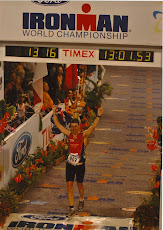
And then finally, it was all done, no more laps, no more wristbands to collect and into the finish chute for a DAYTIME ironman finish. Woo hoo! Finish time 13.04.56 which was well under my target time. And I felt great...


And there was a fair bit of pride in this one. From where I was only 8 weeks ago, a 13.05 seemed completely out of the question. But with an effective training plan that worked, and with good race day decisions on pacing myself, it happened beautifully.

Putting this finish into context, I have only broken 13 hours three times before and this was my 18th ironman event. Although this was the third time I have finished between 13 hours and 13.05...., so it was my 6th best result out of 18 tries.

And from where I was only 8 weeks ago, that made me a VERY happy camper...


It was especially pleasing to be able to share the experience of this event with my beautiful girlfriend Jill.


So that's all from Ironman Western Australia 2010. There have been 7 events now at this venue and I have managed to keep the 100% record intact, completing all 7. Roll on 2011 and IM WA number 8.

Roth, Tab Ultra, Athens Marathon, Coast to Kosiosko

My hips were completely shot after my attempt on the Gold Coast 100km, and while I thought I had healed enough to have a crack at the Gold Coast marathon, sadly they broke down again during that run, but I was close enough to the finish line to walk it in. If I was a horse however, I would have been put down out on the course!

However that meant some serious time of rest, so these three events were all cancelled, as was any attempt at qualifying for the Coast to Kosciosko event for this year.

Tuesday, July 6, 2010

Gold Coast Marathon

Three weeks after my DNF at the Gold Coast 100km event, I was back on the big metal bird and flying up to the Gold Coast again to take part in the marathon.

Its a well supported event, and a great place for people from the southern states of Australia to go to over our winter to get a little bit of warmth. As a guide, Melbourne (2 hours by plane south of the Gold Coast) has been hovering around 11 degrees C lately, while Gold Coast is closer to 20. And sunny!!

But before the marathon there was the little matter of my girlfriend Jill's first 10km run. She was excited, nervous and unhappy that the run started so early in the morning!!

Despite that, she was still a happy little vegemite in the starting area!


To ease congestion, the 10km event was split into two, a sub 60 min group and an over 60 min group. It was self seeded and we put Jill into the first group.

There was a big mob at the start line!!


And then they were off. The elites raced past and dont they just look fantastic as they run. One of the first 3 leaders ended up winning the 10km event in a race record 28.45. Any guesses which one it was?? Shelley? Troop? Or orange singlet man??


For those who guessed Shelley... congratulations... you are a winner. He was still leaping along right near the finish line.


But not long later, Jill came into view. Her first 10km completed and she was a happy girl. If she hadn't stopped to talk to all the aid station kids and visit half the loo's on the course, she would have been quicker... but its about the experience and the finishers medal... and she got both!!


MARATHON
Then it was onto the marathon.

I wasn't feeling overly confident about this event, but at least I had done two weeks of training to get my body used to running again after Comrades and the unfinished 100km run.

My recent run / walk pacing training was much slower than pre Comrades, with a 20km training run done the week before in 2hrs25. So a sub 5 hour marathon looked doubtful if I followed that racing strategy...

But as I stood on the start line with 3 friends who had all done Comrades five weeks ago... I didnt really have any race strategy. I was kind of hoping to do around 4.30, but hadn't really thought about how that would happen.

As we lined up for the start, those pacing strategies were the furthest thing on my mind! I was just here for the experience and to see what would happen! Oh, and to get out of Melbourne's cold weather!!

The start was a long narrow chute just on one side of the road but, amazingly, we were actually running before we got to the start line!!


I started with the 4 hour pacing group - knowing I wouldn't be able to stay with them - and about 2km down the road, pulled off to the right of the course for my first walk break. My HR was already at about 85% of maximum.... too high this early.

I started my run / walk strategy, but could only run about 400m before my HR hit its usual "walking threshold" and then I would walk for 100m to bring it down again. I didnt fancy doing that for another 40km.... so I said "bugger it". When the 4.30 pacing group came past I just pulled in behind them and trundled along... not even looking at my HR.

By 7km I was feeling much better and by 9km I had pulled ahead of the 4.30 pacing group. This was looking promising... I was feeling comfortable, had no calf, hip or quad soreness ... and was rolling along at about 6 mins per km.

The view down the course as am almost at the 10km timing mat, and the leaders are starting to come back the other way.


The leaders were flying along and had a massive lead.


On a nice sunny day, it really is a nice course. This is about 12km in.


Approaching the 14km marker.


At 25km in I was still running reasonably well.... ok I know the photo shows there isn't a great stride happening here... but I was making my way through the field!


By 35km, I was beginning to slow. My hips were starting to really hurt and my running plan (as it turned out) of running 5km and then stopping for a Gu... was in trouble. I needed a few walks between 30-35km to take the pain out of my hips.

But my splits up to 35km were remarkably event:

5km 32.30 ave HR 148
10km 30.52 ave HR 157
15km 30.13 ave HR 158
20km 29.57 ave HR 159
25km 29.16 ave HR 162
30km 30.21 ave HR 165
35km 31.59 ave HR 164

And then just after 35km the hips just got too painful. It was just like the 100km run all over again. I could barely lift my legs, the hips had a sharp pain in the joints on both sides and even walking was painful.

Running was just not an option... especially as I didnt want to do any damage to myself, so once I hit the 37km mark... it was just a slow walk home.

But the scenery was entertaining... is this what you REALLY want to do just after being married!!?? (they had "just married" signs on their backs!)


After the 37km mark I got passed by a lot of people.... all those that I had passed from 10km to 35km it seemed....


The pelicans were a nice distraction


And finally the 40km sign came up. I was walking at about 12 mins per km (ok we should really call it hobbling rather than walking), and after a nice consistent set of 5km splits... the 35-40km split took 52.51. But the Ave HR was down to 133 for that 5km...


There were lots of bands placed around the course to keep the groove happening!!


Finally I hobbled back down the Gold Coast highway towards the finish line


Under the gantry


Down one more little straight


And FINALLY down to the finish line... to finish in a net time of 4.54.48.


And then it was done. It was a funny old day, awful for a while, wonderful for a while, and then painful for a while. :)

The hobble back to the car was particularly slow.

But now its all about recovery before I head off on holiday to Europe!! Hooray!!

Finally, I will leave with with a photo you dont often get to see, the view back down the finishing chute having just finished.

Gold Coast 100km run

On 13 June I lined up for the 100km ultra marathon on the Gold Coast. This was the first time I had attempted this distance and, having done the Comrades Marathon in South Africa only 2 weeks before, I wasn't sure the body was ready.

Why wasn't I sure? Well I hadn't yet had a decent nights sleep since I had come back from South Africa, which was only 5 days before the run. And of course I hadn't done any training since Comrades, which at 89km, is bound to leave a bit of fatigue in the body.

After being crowded in the 16,000 plus runners of Comrades, this was a completely different event. There were 28 starters in the 100km event... and I was given number 6. Yep, single digits...

Race kit collection was "very" low key. You went to a nearby shopping centre and found the right sports store, where someone wrote your number on bib. You didnt even get pins until race morning, let alone a t-shirt or drink bottle! This was very much a low key event.

With such a small field, there were no road closures. You ran along the public footpath and did your best (a) not to look silly running along with a number on your shirt (b) to avoid prams, people and dogs and (c) to make sure you knew where the course went.

The 100km course was made up of 4 loops of a 25km course, 12.5km and 12,5km back again. It was described as flat and fast, which I guess it mostly was, if you ignored the 83 steps you go up and the 5km mark... and of course coming down them again on the way back.

Still at 6am I was there lined up with everyone else, shivering a bit in the cold, but prepared to run (or at least run / walk) for the entire day. The event had a 12 hour cut off.

At 6am we lined up and we were counted down and then the organiser said "go" and with that, we were off.

I felt good for the first 1km, but by 2km I was in a bit of trouble. My quads were sorer than they should have been and my heart rate was too high and I was already at the back of the field. I had to keep going at a reasonable pace though, as I wasn't 100% sure of the route (the maps werent that great).

However, all I wanted to do was to finish, so I set about keeping a few people in sight so I wouldnt get lost, and getting through each 12.5km section inside 1hr 30, which would keep me on track for a 12 hour finish.

I made it through the first 12.5km in 1.17.21, well under time, but the average HR of 152, was 15 beats per min higher than where I wanted it to be. And my quads were hurting badly already.

At 25km and completing lap one, I discarded my run jacket (even though the wind was still cool) but got there in 2.35.. well under the 3 hour target mark, but the pain was increasing.

At 37.5km the pain was considerable but I was still mentally strong, even though I was now running at almost half ironman intensity, even though it was much slower than marathon pace. I was in significant pain and slowing a bit, finishing this section in 1.24.23... but I was still gaining time on the 12 hour cut off split.

Coming back to finish lap 2 and 50km, the pain was significant and I was having longer walk breaks and finished this section in 1.27.55, and the 50km in 5.27.24.

I asked the organiser at this time whether finishers medals would be provided for anyone who finished after 12 hours (thinking that it was highly likely I would slow down for the second half) and happily he said they would. He didnt give me a final cut off, but indicated that as long as you finish in a reasonable time, all would be good.

In a good space, I set off hobbling down the road again. The quads were so sore, I could barely lift my legs. The soles of my feet were rubbing along the ground with every step and my hips were extremely sore with sharp pain in the hip joint, something that I had never experienced before.

I was still mentally strong so I kept waddling on until at about 52km, I had to walk. It hurt to recommence running, with the pain in the hips, so I decided an extended walk would be the go. After all, the time constraints had been lessened.

However I was walking in pain and certainly not fast.

I got to the 55km point and those dreaded steps and tried to hoist myself up the hand rail to get up the first step. The pain in my hip as I tried to lift myself up was really bad, and with 82 more steps to go, and what was looking like 45km of painful walking to get to the finish line... I decided that the body had had enough.

So I slowly and painfully hobbled back to the aid station that was about 400m away, and got a lift back to the start and pulled out.

It was disappointing not to finish, but it was definitely the right thing to do. I was barely able to hobble (you couldnt really call it walking) and I am not even sure I could have done 45km like that.

So it was back to the hotel and soaking the legs in the ice cold swimming pool for a while and then just try and recover.

So my first 100km effort ended in disappointment and a DNF. But I will be back to try again!!